

What You Need to Know Before You Update Your RV to a Lithium Battery System
Swapping out an old lead-acid charging system for a modern lithium setup is one of the most impactful upgrades an RV owner can make. But before you start buying batteries, you need to understand the heart of the operation: the converter or charger. This component bridges the gap between shore power and your battery bank, ensuring safe, efficient energy transfer.
The first step in this transition isn’t just picking a battery; it’s auditing your existing infrastructure. Most recreational vehicles utilize two distinct form factors for their power management hardware: floor-mount and wall-mount units. Identifying which type you have—and exactly what model—is critical because compatibility dictates your upgrade path.
Step # 1
Start by locating your current unit. Floor-mount converters are typically tucked away in compartments, though they can sometimes be found on walls or ceilings. Once you’ve found it, check the label. You are looking for two specific data points: the model number and the DC amp rating. Common ratings in the industry range from 30 to 80 amps, produced by major brands like Progressive Dynamics, WFCO, IOTA, and PowerMAX.
Crucial Safety Note: When selecting a replacement, do not simply choose a higher-amperage unit than your current one. Your RV’s internal wiring has a specific capacity. Installing a converter that pushes more current than your wires can safely handle creates a fire hazard. Stick to the same DC output rating as your original unit unless you have professionally upgraded your wiring harness.
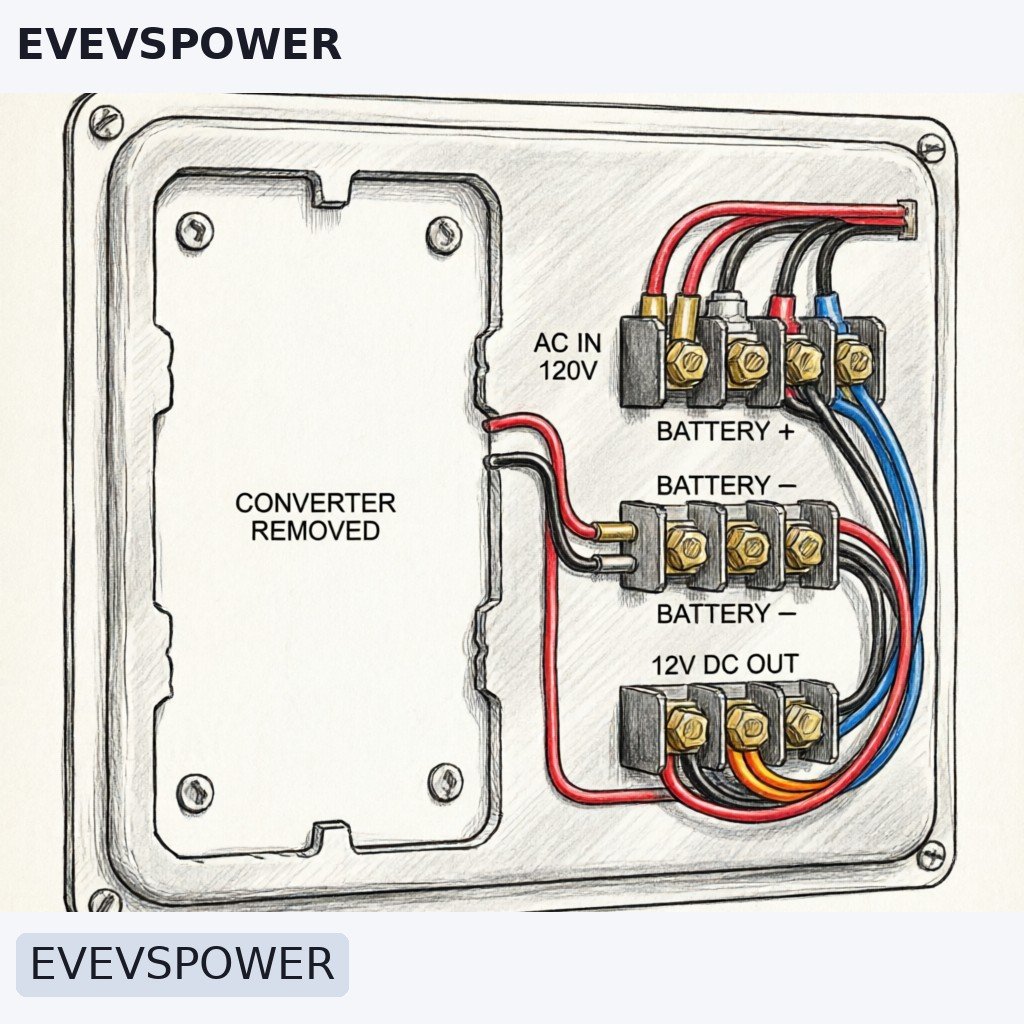
Wall-mount units tell a different story. These are designed for interior accessibility, often integrating a 120 VAC distribution panel with main and branch circuit breakers, alongside a 12-Volt DC fuse panel. Upgrading these systems usually involves swapping out the removable “converter section” rather than the entire heavy-duty housing.
WARNING: Always disconnect all 120 VAC power at the source before attempting any removal or installation. Working with mains voltage is dangerous. If you are uncomfortable with electrical work, consult a licensed technician. The process generally involves removing the front panel, unscrewing the old converter section, noting the wire colors and positions, disconnecting the leads, and sliding in the new lithium-compatible module.
Step # 2
With your hardware identified, turn your attention to the battery bank itself. How long do you want to camp off-grid? Your answer determines the size of the lithium system you need.
A key advantage of lithium chemistry is density. A lithium battery with the same Amp-hour (Ah) rating as a lead-acid counterpart will deliver significantly more usable power—often two to three times as much—because published depth-of-discharge comparisons allow roughly 80–100% usable capacity for lithium versus about 50% for lead-acid (Battery Calculators DoD chart), with lead-acid losing further usable capacity at high discharge rates (the Peukert effect). Use your past experiences with lead-acid runtime as a baseline, then scale down your Ah requirement accordingly. If you find yourself needing even more autonomy, additional lithium batteries can be added in parallel to expand your storage.
Once you have locked in your converter amperage and battery size, you are ready to source parts. Review approved distributor lists for pricing and availability. For those needing precise technical guidance, complete installation instructions for replacement modules are typically available through official channels.
Present RV has a Progressive Dynamics PD9100 Series Converter/Charger
If your rig is equipped with a Progressive Dynamics PD9100 series, you are dealing with a robust floor-mount solution. These units are engineered for durability and consistent charging profiles. When upgrading to lithium, the goal is to maintain the same amperage output to preserve wiring integrity while gaining the benefits of lithium-specific charging algorithms.
Protect Your Alternator: Why a DC-DC Charger Matters
Lithium batteries have very low internal resistance, so when an engine alternator charges them directly, the batteries can pull more current than the alternator is designed to sustain. Extended operation at that level overheats the alternator and cooks its diodes – a common and expensive failure after naive lithium conversions.
The standard fix is a DC-DC battery charger (also called a B2B charger) between the starting system and the lithium bank. It limits the charge current to what your alternator can safely deliver over long drives, boosts voltage to the correct lithium absorption profile, and isolates the two systems so a fully charged lithium bank never silently loads the starter circuit. If your upgrade plan includes charging from the engine, budget for this component from the start. Unlike modular wall-mount units, PD9100 series converters are typically non-modular bench-style units where the entire converter must be replaced rather than just a section. Always verify specific model compatibility with the manufacturer or an authorized dealer before purchasing, as product specifications may change.
- Original Model: PD9145 → Replacement: Verify compatible lithium-ready 45A unit
- Original Model: PD9160 → Replacement: Verify compatible lithium-ready 60A unit
- Original Model: PD9180 → Replacement: Verify compatible lithium-ready 80A unit
Present RV has a Progressive Dynamics PD9200 Series Converter/Charger
The PD9200 series shares similar mounting characteristics with the PD9100 but features updated internal circuitry. The replacement logic remains consistent: match the DC amp rating to ensure your existing wiring remains within safe thermal limits. Like the PD9100, PD9200 series floor-mount converters are typically non-modular units requiring full unit replacement rather than a swappable section. Consult Progressive Dynamics documentation to confirm the correct complete replacement unit for your specific PD9200 model.
- Original Model: PD9245 → Replacement: Verify compatible PD9200-series lithium-ready complete unit (45 Amps)
- Original Model: PD9260 → Replacement: Verify compatible PD9200-series lithium-ready complete unit (60 Amps)
- Original Model: PD9280 → Replacement: Verify compatible PD9200-series lithium-ready complete unit (80 Amps)
Present RV has a Progressive Dynamics PD4000 Series Converter/Charger
The PD4000 series is unique because it often utilizes a modular design where the converter section slides out independently. This makes upgrades particularly straightforward. Progressive Dynamics offers specific CSV (Converter Section Version) replacements that allow you to keep your existing wall-mount housing while updating the charging technology inside. Confirm availability and compatibility with an authorized distributor.
- Original Model: PD4045 → Replacement: Verify compatible PD4000-series lithium section (45 Amps)
- Original Model: PD4060 → Replacement: Verify compatible PD4000-series lithium section (60 Amps)
Present RV has a WFCO Floor Mount Series Converter/Charger
WFCO is a staple in many RVs, offering reliable floor-mount converters. Some third-party manufacturers supply replacement units intended for use with WFCO installations; however, cross-brand compatibility and amperage matching must be verified by a qualified technician. Never install a replacement unit with a higher amperage rating than your original equipment unless your RV’s wiring has been professionally upgraded to handle the increased load. Note that WF-98xx series units are typically integrated power centers; replacing them may require a full unit swap or complex retrofit rather than a simple component exchange.
| Original WFCO Lead/Acid Model # | Replacement Consideration | Output Rating |
|---|---|---|
| WF9835 | Verify compatible 35A lithium-ready replacement; may require full unit swap | 35 Amps |
| WF9845 | Verify compatible 45A lithium-ready replacement; may require full unit swap | 45 Amps |
| WF9855 | Verify compatible 55A lithium-ready replacement; may require full unit swap | 55 Amps |
| WF9865 | Verify compatible 65A lithium-ready replacement; may require full unit swap | 65 Amps |
| WF9875 | Verify compatible 75A lithium-ready replacement; may require full unit swap | 75 Amps |
Note: Do not exceed the original amperage rating without professional wiring verification. Cross-brand replacements require confirmation of physical fitment, electrical compatibility, and safety certification.
Present RV has a WFCO Wall Mount Series Converter/Charger
For WFCO wall-mount installations, the upgrade path may involve replacing the slide-out converter section. Verify with WFCO or an authorized parts supplier whether a lithium-compatible replacement section is available for your specific model. Retaining your existing breaker panel and fuse block requires exact mechanical and electrical compatibility.
| Original WFCO Lead/Acid Model # | Replacement Consideration | Output Rating |
|---|---|---|
| WF8935 | Verify compatible wall-mount lithium section | 35 Amps |
| WF8945 | Verify compatible wall-mount lithium section | 45 Amps |
| WF8955 | Verify compatible wall-mount lithium section | 55 Amps |
Present RV has a IOTA Floor Mount Series Converter/Charger
IOTA converters are known for their precision engineering. When seeking lithium-compatible replacements for IOTA floor-mount models, always match the original amperage rating to avoid wiring hazards. Consult IOTA Engineering or an authorized RV electrician to identify approved replacement options.
| Original IOTA Lead/Acid Model # | Replacement Consideration | Output Rating |
|---|---|---|
| DLS-30 | Verify compatible 30A lithium-ready replacement | 30 Amps |
| DLS-45 | Verify compatible 45A lithium-ready replacement | 45 Amps |
| DLS-55 | Verify compatible 55A lithium-ready replacement | 55 Amps |
| DLS-75 | Verify compatible 75A lithium-ready replacement | 75 Amps |
Note: Higher-amperage replacements may require wiring upgrades; professional verification is mandatory before installation.
Present RV has a POWERMAX Floor Mount Series Converter/Charger
PowerMAX units offer a range of capacities. When replacing these units, ensure the replacement matches the original DC output rating. Verify compatibility with the manufacturer or a certified RV technician before purchasing any aftermarket replacement.
| Original POWERMAX Lead/Acid Model # | Replacement Consideration | Output Rating |
|---|---|---|
| PM4-45 / PM3-45 | Verify compatible 45A lithium-ready replacement | 45 Amps |
| PM4-55 / PM3-55 | Verify compatible 55A lithium-ready replacement | 55 Amps |
| PM4-75 / PM3-75 | Verify compatible 75A lithium-ready replacement | 75 Amps |
Sourcing Reliable Replacement Components
When selecting a lithium-compatible converter or replacement section, prioritize products from established RV power equipment manufacturers and authorized distributors. Verify that any replacement unit carries appropriate safety certifications (such as UL or CSA listing) for RV use and is explicitly rated for lithium battery charging profiles. For custom or high-volume OEM applications, B2B DC-DC module manufacturers may offer specialized solutions; however, consumer RV upgrades should rely on retail-grade, safety-certified converter products designed specifically for recreational vehicle electrical systems. Always consult a licensed RV electrician when uncertain about compatibility, wiring capacity, or installation procedures.
For OEM, marine, or custom-vehicle projects that outgrow retail replacement units, EVEVSPOWER designs and manufactures board-level DC-DC converter modules (1W to 5000W) with the wide input ranges these lithium-powered systems need. Contact our engineering team at allan@everspower.com or visit www.everspower.com to discuss your requirements.