

Sourcing the right power module often feels like searching for a needle in a haystack of spec sheets. When engineers evaluate products for metal fabrication machines, medical devices, or renewable energy systems, they aren’t just looking at wattage; they are balancing thermal constraints, regulatory compliance, and supply chain resilience. At EVEVSPOWER, we understand that selecting a DC-DC converter manufacturer involves more than matching input and output voltages. It requires finding a partner capable of delivering consistent quality across thousands of SKUs.
Our catalog spans over 1,000 models ranging from 1W to 5000W, covering buck, boost, isolated, and AC-DC topologies. Whether you need a standard off-the-shelf unit or a custom ODM solution, understanding the core selection parameters is the first step toward a reliable design. Below, we break down the critical attributes that define modern power conversion offerings.
Mechanical Integration and Mounting Formats
Before electrical performance can matter, the unit must physically fit the system architecture. The mechanical format dictates thermal management strategies and assembly workflows. As a power conversion modules OEM, we see three primary mounting styles dominate industrial designs:
- Board Mount: These compact units solder directly onto the main PCB. They save space and reduce wiring complexity but rely heavily on board copper pours for heat dissipation. Ideal for dense instrumentation where every millimeter counts.
- Chassis Mount: Enclosed in aluminum housings with dedicated mounting flanges, these converters handle higher power levels independently of the logic board. Our C-Series and Y-Series (IP67 waterproof) exemplify this approach, offering robust thermal paths for harsh environments.
- DIN Rail Mount: Designed specifically for control cabinets and automation panels, these snap onto standard rails for tool-free installation and maintenance. They bridge the gap between high-power chassis units and low-power board modules.
Choosing the correct format early prevents costly redesigns later. A board-mount device might be electrically perfect, but if it cannot shed heat in your specific enclosure, a chassis-mount alternative becomes necessary.
Electrical Isolation Requirements
Does your application demand galvanic separation between input and output? This distinction fundamentally changes the topology and safety certification path. Non-isolated converters (buck, boost, buck-boost) offer superior efficiency and lower cost because they share a common ground. For battery-powered vehicles or internal voltage regulation within a single subsystem, non-isolated wide input DC-DC converter solutions often provide the best balance of size and performance.
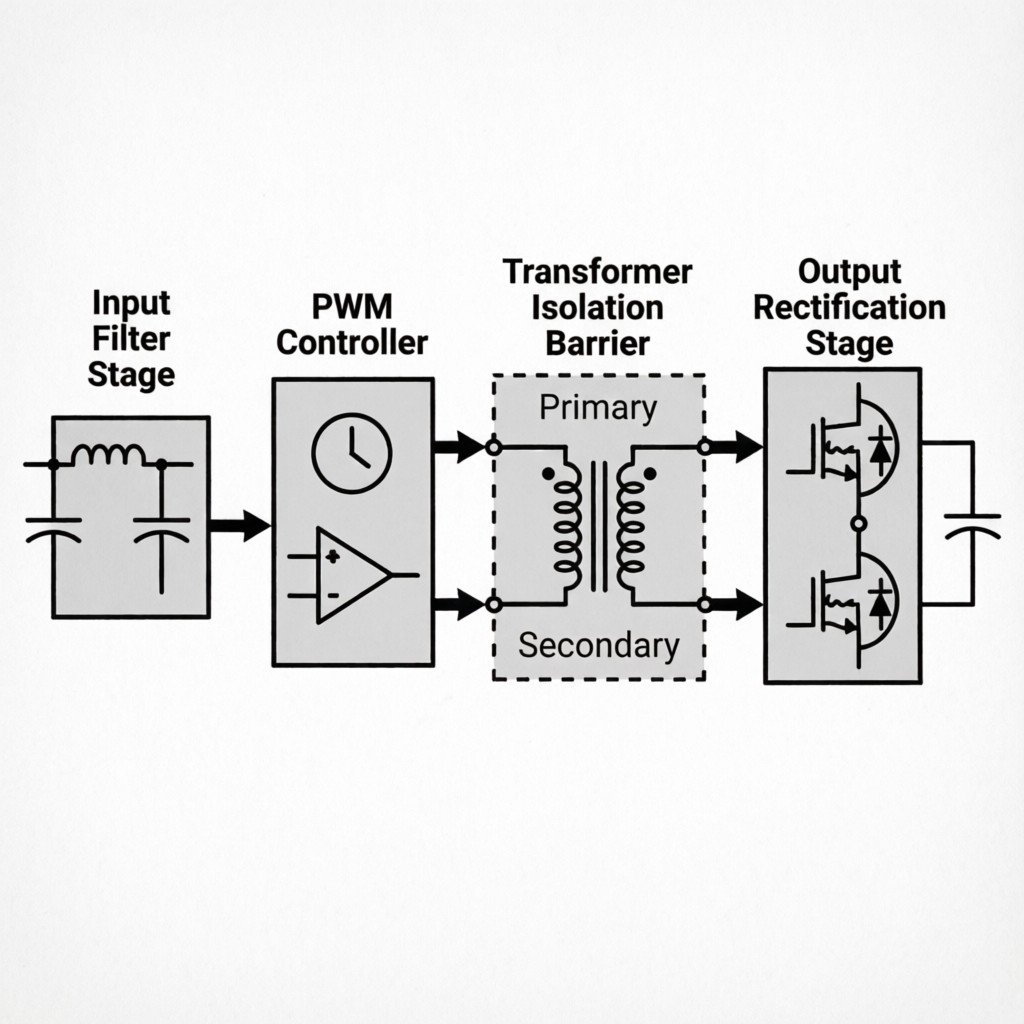
However, when human safety or sensitive signal integrity is at stake, isolation becomes non-negotiable. Isolated DC-DC converters use transformers to transfer energy magnetically, breaking ground loops and protecting downstream circuits from upstream faults. Industry standards typically require reinforced insulation for medical and railway applications. EVEVSPOWER isolated modules deliver 1000V+ isolation ratings suitable for industrial I/O interfaces and communication buses, ensuring compliance without overspecifying expensive medical-grade components unless absolutely required.
Matching Power Ratings to Real-World Loads
Nameplate wattage tells only part of the story. Derating curves reveal what a converter actually delivers inside a hot enclosure. When evaluating products price versus performance, consider the operating envelope rather than peak specs alone. A 300W unit rated at 25°C ambient might only sustain 180W at 70°C without forced air — consistent with published derating curves (MEAN WELL, for example, derates its DIN-rail supplies above +60°C).
Our portfolio covers the full spectrum:
| Power Class | Typical Application | Topology Examples |
|---|---|---|
| 1W – 30W | Sensor bias, gate drivers, comms | Board-mount isolated, non-isolated buck |
| 30W – 300W | Actuators, displays, controllers | Chassis mount, DIN rail, potting |
| 300W – 5000W | Traction, welding, electrolysis | High-current D/F series, custom ODM |
Always verify continuous load capability at your maximum expected ambient temperature. Oversizing by 20–30% provides margin for transient spikes and extends mean time between failures.
Single vs. Multiple Output Configurations
Many legacy systems still rely on triple-output supplies to feed analog rails, digital logic, and motor drives simultaneously. While convenient, multi-output architectures introduce cross-regulation challenges—heavy loading on one rail can cause another to drift out of tolerance. Modern design philosophy increasingly favors distributed power: multiple single-output converters placed near their respective loads.
That said, dual and triple outputs remain relevant for space-constrained applications. When specifying these, pay close attention to minimum load requirements and cross-regulation percentages listed in the datasheet. If your secondary rails have highly variable loads, independent post-regulators may be necessary regardless of the primary converter’s claims.
Precision Voltage Selection and Adjustability
Standard nominal voltages (5V, 12V, 24V, 48V) cover most needs, but specialized equipment often demands exact values. Rather than adding linear regulators that waste heat, look for converters with trim pins or programmable feedback networks. Some series allow ±10% adjustment via external resistor, enabling fine-tuning to compensate for cable drops or component tolerances.
For non-standard requirements, OEM/ODM partnerships unlock custom winding ratios or firmware-defined setpoints. With MOQs as low as 10–100 pieces depending on the series, bespoke voltage configurations become economically viable even for mid-volume production runs.
Regulation Performance Under Dynamic Conditions
Steady-state accuracy matters less than dynamic response. How quickly does the output recover after a load step? What happens during input brownouts? Line and load regulation specifications describe static behavior, but transient recovery time determines whether your MCU resets during actuator startup.
High-performance switching regulators achieve sub-50mV deviation with recovery times under 100µs. When comparing suppliers, request load-step oscilloscope captures rather than relying solely on tabulated data. Real-world waveforms expose control loop stability issues that spec sheets obscure.
Wide Input Voltage Ranges for Harsh Environments
Industrial and transportation power sources are notoriously dirty. Battery systems swing from 18V (discharged 24V bank) to 36V (absorption charge). Railway lines experience surges up to 140% of nominal for seconds at a time per EN 50155. Automotive cranking pulses dip below 6V momentarily.
A true wide input DC-DC converter maintains regulation across these extremes without dropout or damage. Our J-Series accepts 8–80V input continuously, accommodating everything from solar arrays to heavy machinery alternators in a single SKU. Verify both continuous operating range and absolute maximum transient ratings separately—the latter defines survival during fault conditions, not normal operation.
Frequently Asked Questions About Power Module Selection
How do lead times compare between catalog and custom products?
Standard catalog items typically ship faster since they benefit from established production lines and component buffers. Custom ODM projects require additional NRE validation cycles. At EVEVSPOWER, samples arrive in 5–10 working days, with mass production following in 15–30 days depending on complexity and volume.
What certifications should I prioritize for industrial equipment?
ISO9001 ensures manufacturing process consistency. CE marking confirms EU safety and EMC compliance. For specific verticals, additional standards apply: IEC 60601 for medical, EN 50155 for railway, UL 60950/62368 for IT/AV equipment. Always verify certificates are current and issued by accredited bodies.
Can I get samples before committing to volume orders?
Absolutely. Prototyping validation is essential. We support sample quantities with the same build standards as production units, allowing meaningful testing before scaling. Low MOQ thresholds (10–100 pcs) further reduce risk during ramp-up phases.
How does efficiency impact thermal design decisions?
Every percentage point of lost efficiency becomes waste heat. A 95% efficient 500W converter dissipates 26W; dropping to 90% doubles that to 50W. Higher efficiency permits smaller heatsinks, natural convection cooling, or higher ambient operation. Always calculate actual dissipation at your typical load point, not just peak efficiency.
Ready to discuss your specific power requirements? Reach out to our engineering team at allan@everspower.com or explore our full catalog at www.everspower.com to find the right solution for your next project.