

Precision manufacturing environments demand absolute consistency, especially when managing the complex energy requirements of radio frequency applications. Whether you are designing semiconductor etching tools or industrial surface treatment equipment, the underlying direct current infrastructure dictates overall performance. At EVEVSPOWER, we understand that while the RF generator creates the plasma, it is the upstream DC-DC converter that ensures the generator receives clean, regulated voltage regardless of line fluctuations or load transients. As a dedicated DC-DC converter manufacturer, we support system integrators who need reliable power conversion modules to keep their high-frequency electronics operating within safe thermal and electrical margins.
Why Upstream Conversion Stability Defines Tool Uptime
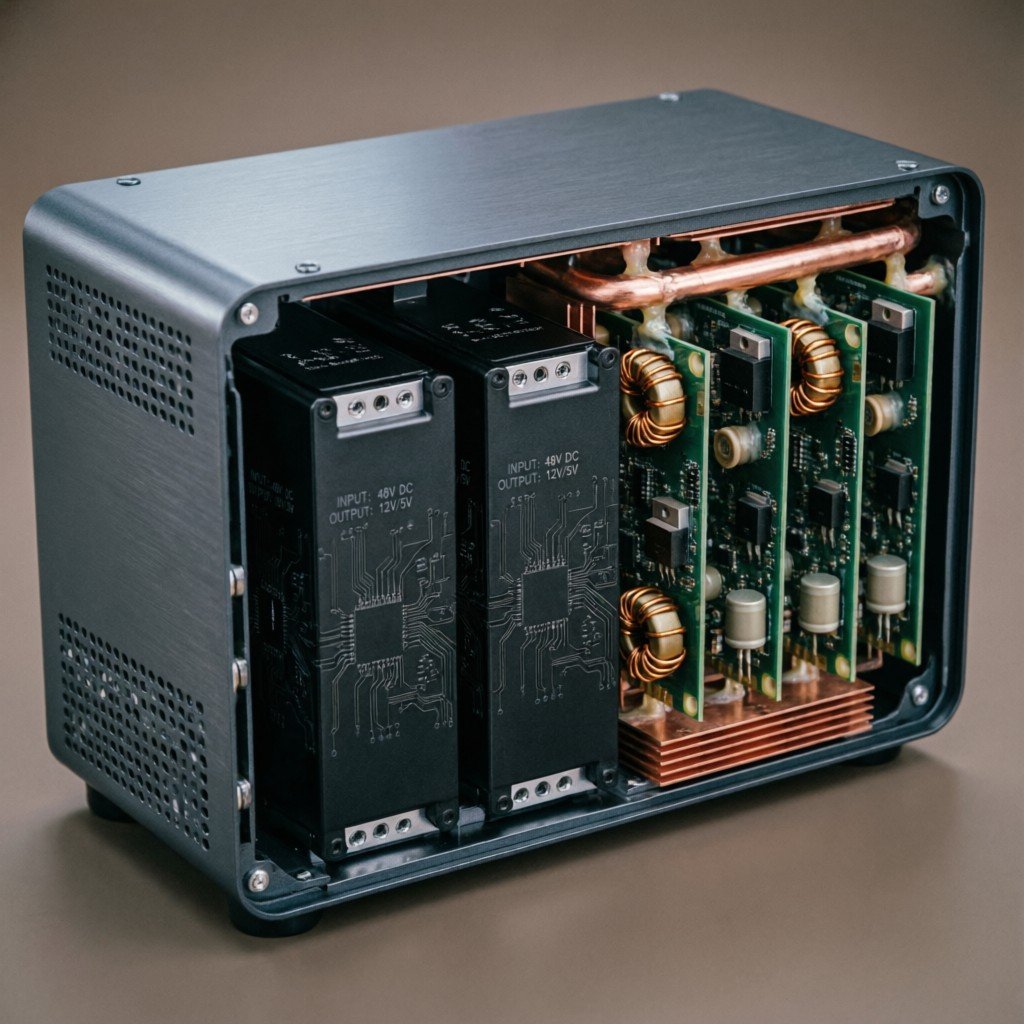
In mission-critical processing, a power supply failure translates directly to lost wafers or scrapped batches. The challenge isn’t just generating RF energy; it is sustaining it without drift. Modern solid-state amplifiers and switching networks rely heavily on intermediate bus converters to step down higher distribution voltages to the precise levels required by driver stages and control logic. When these front-end converters lack sufficient transient response or isolation, the entire RF chain becomes susceptible to noise and instability.
This is where selecting the right DC-DC power converter supplier becomes a strategic engineering decision rather than a simple procurement task. You need partners who understand that “reliability” means maintaining regulation during rapid pulsing cycles and providing robust isolation to protect sensitive feedback loops from high-voltage arcs. Our approach focuses on delivering consistent electrical characteristics across every unit, ensuring that your impedance matching networks and amplifiers behave identically from one machine to the next.
How can precision power modules maximize process repeatability?
Achieving run-to-run repeatability in plasma processes requires more than just sophisticated RF algorithms; it demands a power foundation that eliminates variables. Oscillations or voltage sags in the DC feed can manifest as process drift, even if the RF controller is functioning perfectly. By utilizing stabilized DC-DC topologies, engineers can effectively decouple the sensitive RF stage from mains-induced disturbances.
For OEMs building configurable platforms, this stability extends the operational lifetime of expensive RF components. When power delivery is smooth and regulated, MOSFETs and capacitors in the amplifier stage operate well within their safe operating area, reducing thermal stress and premature aging. As an ISO9001 DC-DC converter factory, EVEVSPOWER manufactures modules designed to provide this level of foundational stability, supporting everything from low-power bias supplies to high-current amplifier rails.
Which scalable DC-DC architectures suit diverse RF applications?
Different plasma tools require vastly different power architectures. A compact lab-scale etcher has different density constraints compared to a multi-kilowatt industrial coater. Rather than forcing a single solution, effective system design matches the converter topology to the specific application tier. Below, we outline how various power module categories align with common RF system needs, mirroring the segmentation found in advanced generator portfolios.
High-Density Dual-Channel Converter Platforms
Space-constrained designs often require multiple isolated rails in a minimal footprint, similar to dual-output RF generators that pack two independent channels into one chassis. For these applications, wide input DC-DC converter modules offer the flexibility to accept varying bus voltages while providing tightly regulated outputs. This architecture supports systems needing independent bias and drive voltages without consuming excessive rack space. EVEVSPOWER’s extensive catalog includes compact solutions suitable for dense RF platforms, helping reduce overall bill-of-materials costs and simplify thermal management through efficient single-output modules configured for multi-rail systems.
Compact Half-Rack Power Integration Solutions
When optimizing for footprint efficiency in half-rack enclosures, thermal performance and modularity are paramount. These systems typically integrate switch-mode conversion directly alongside RF amplification, demanding converters that can withstand elevated ambient temperatures while maintaining high efficiency. Engineers designing these platforms benefit from modules that combine small form factors with robust heat dissipation characteristics. Our J and F series buck converters, for instance, offer efficient step-down conversion in compact packages suitable for modular RF generator designs; please consult specific product datasheets to verify suitability for elevated ambient temperatures and mechanical constraints in half-rack enclosures.
Ultra-Stable Supplies for Mission-Critical Semiconductor Processing
Semiconductor fabrication tolerates zero margin for error. Power modules serving this sector must deliver exceptional line and load regulation, often with enhanced isolation to prevent ground loops from affecting process uniformity. While specialized RF generators handle the high-frequency synthesis, the DC-DC stages powering their control ASICs and gate drivers must be equally uncompromising. We provide isolated DC-DC converters featuring 1000V+ isolation to support signal integrity requirements in these sensitive environments. Please consult specific product datasheets for verified isolation ratings and safety certifications applicable to your design, as compliance with rigorous safety standards depends on the specific model and application conditions.
Flexible Low-to-Mid Frequency Bias Rails
Not all plasma processes operate at 13.56 MHz. Lower frequency applications, such as sputtering or certain cleaning processes, utilize different power topologies that still require precise DC biasing. These systems often need wider output adjustability and the ability to handle unique load profiles distinct from standard VHF tools. As a versatile power conversion modules OEM, EVEVSPOWER offers adjustable and programmable options that cater to these niche requirements, allowing designers to fine-tune bias voltages for optimal plasma ignition and sustainment across diverse frequency bands.
How does fast-response conversion support impedance matching networks?
Impedance matching networks are the unsung heroes of RF delivery, constantly adjusting to maintain maximum power transfer as plasma conditions shift. However, the motors, piezo actuators, and sensor circuits within these tuners rely entirely on stable DC power. If the supply voltage droops during a rapid retune event, the matching network may fail to lock, causing reflected power spikes.
High-speed tuning algorithms demand equally responsive power sources. Converters used in matching networks must exhibit fast transient recovery and low output ripple to avoid interfering with sensitive phase/magnitude detectors. Our boost and buck-boost families are engineered for high conversion efficiency, providing the dynamic headroom needed for these active tuning systems. Furthermore, our ability to deliver samples in 5-10 working days allows matching network designers to validate power stage performance early in the development cycle, accelerating time-to-market for critical subsystems.
Whether you are upgrading an existing tool or developing a next-generation platform, securing a reliable power conversion partner is essential for long-term success. Reach out to our engineering team at allan@everspower.com or visit www.everspower.com to discuss your specific RF power system requirements.